
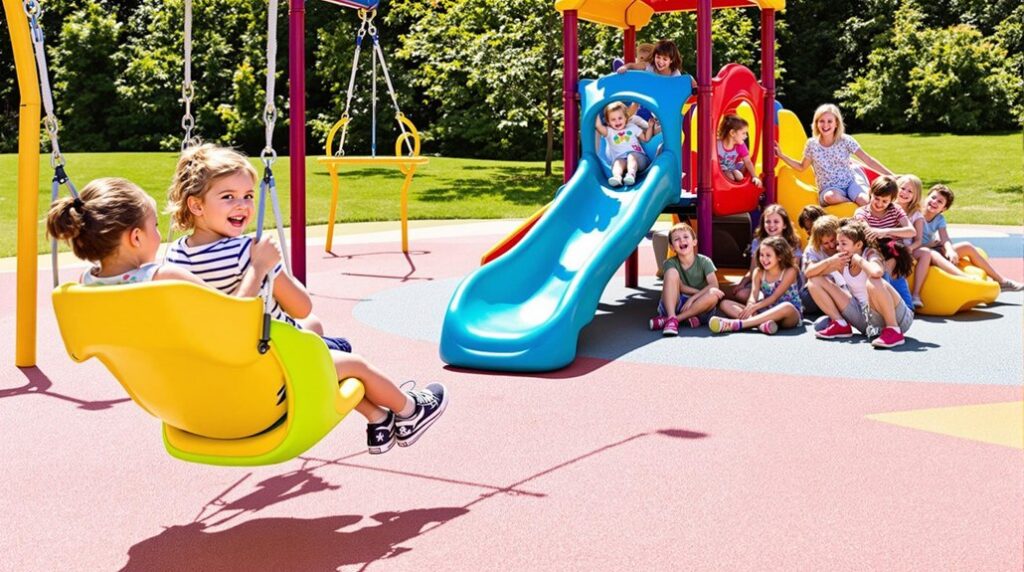
When choosing age-appropriate playground equipment, consider the developmental needs of children within specific age groups. For infants (6–23 months), low-height slides and textured surfaces enhance safety and sensory exploration. Toddlers (2–5 years) benefit from climbing structures that promote balance, while school-age children (5–12 years) thrive with more challenging climbing features and cooperative elements. Each piece should be designed to foster physical, cognitive, and social skills, ensuring a safe play environment. There’s much more to explore about effective playground design.
Playground Safety Guidelines for Toddlers
When you’re selecting playground equipment for toddlers, it’s essential to prioritize safety, as young children are particularly vulnerable to injuries. Begin by ensuring the play area features shock-absorbing surfaces like wood chips or shredded rubber, avoiding hard surfaces such as concrete. Design separate play zones to keep toddlers away from older children’s equipment, reducing collision risks. For elevated structures, include guardrails on platforms higher than 12 inches to prevent falls. Limit climbing equipment height to 4 feet, and incorporate non-slip surfaces on steps and slides. Maintain clear sight lines for caregivers, ensuring unobstructed pathways for easy supervision. Regularly inspect the equipment for hazards and remove any items that could cause entrapment or injury, promoting a safer play environment. Additionally, consider incorporating thermoplastic playground markings to enhance structured play and define safe zones for toddlers.
Essential Equipment for Infants (6–23 Months)
Selecting essential playground equipment for infants aged 6 to 23 months requires careful consideration of their developmental needs and safety. Ideal equipment includes low-height slides and platforms that minimize fall risks while encouraging safe exploration. Crawl tubes and small tunnels aid motor skill development, while textured surfaces provide tactile stimulation for sensory integration. Bright, contrasting colors enhance visual engagement. Additionally, manipulative panels with simple shapes promote fine motor skills and hand-eye coordination. Sensory panels foster early learning through auditory, visual, and tactile experiences. Safety is paramount, so verify equipment uses high-quality, non-toxic materials and features rounded edges. Designs should allow for caregiver supervision, with open sightlines and modular structures that adapt to infants’ evolving capabilities. Incorporating durable playground markings can enhance the play experience by providing visually stimulating layouts that encourage exploration and engagement.
Developmentally Appropriate Play Features for Preschoolers (2–5 Years)
Developmentally appropriate play features for preschoolers aged 2 to 5 years are essential for fostering physical, social-emotional, and cognitive growth. Low climbing structures, tunnels, and short slides promote balance and motor skills, while spring riders and balance beams enhance coordination. Social-emotional development thrives through cooperative play elements like see-saws and role-play structures, encouraging collaboration and imagination. Interactive activity panels stimulate cognitive enrichment, offering opportunities for cause-effect learning and sensory exploration. Safety is paramount, with features such as non-slip surfaces, guardrails, and clear sightlines ensuring a secure play environment. Adaptive features, including ramps and sensory-rich textures, support inclusive access for all children. These carefully designed elements create a holistic playground experience that meets the diverse needs of preschoolers. Additionally, child safe thermoplastic is crucial for ensuring the durability and safety of playground markings, making play areas both vibrant and secure for young children.
Engaging Activities for School-Age Children (5–12 Years)
Engaging activities for school-age children aged 5 to 12 years are essential for promoting physical fitness, social skills, and cognitive development. Climbing structures, including rope climbers and challenging climbing routes, enhance strength and coordination while fostering problem-solving skills. Sliding and swing equipment encourages balance and physical activity, fundamental for gross motor development. Cooperative elements like merry-go-rounds and see-saws promote teamwork and social interaction, important at this age. Imaginative play zones spark creativity, allowing children to explore various scenarios. Open spaces for games facilitate self-directed play, further enhancing communication skills. Additionally, integrating educational play elements, such as puzzles and dynamic net structures, offers mental stimulation, making playgrounds significant environments for holistic development in school-age children. Playground markings can also enhance social interaction by providing structured games that encourage collaboration among peers.
Importance of Sensory Play in Early Childhood
Sensory play serves as an essential component in early childhood development, as it actively engages children in hands-on experiences that stimulate their senses and promote learning. This type of play supports brain development by building nerve connections and enhancing cognitive abilities through multisensory input. It strengthens problem-solving skills and aids memory retention, while also fostering curiosity-driven neural pathways. Additionally, sensory play aids language growth by developing descriptive vocabulary and teaching nonverbal emotional expression. It enhances fine motor skills through activities that improve coordination and dexterity. Furthermore, sensory experiences contribute to emotional regulation by providing calming input and reducing anxiety. Finally, these activities advance social skills by encouraging cooperation and empathy during collaborative play, ultimately ensuring holistic development. Incorporating high-quality thermoplastic materials into playground designs can further enrich sensory play experiences for children.
Key Components of Collaborative Play Equipment
Collaborative play equipment is essential for fostering social interaction and teamwork among children, as it encourages them to engage with one another in various activities. Key components include slides that promote shared fun, while merry-go-rounds require children to move in sync, enhancing cooperative play. Climbers foster teamwork as kids assist each other in reaching higher levels, and swing zones, especially with tire swings, support social interaction. Overhead events, like rings or ropes, encourage physical collaboration. Inclusive elements, such as accessible slides and transfer stations, guarantee all children can participate. Activity zoning further enhances collaboration by organizing play areas, enabling focused interaction. Together, these components create a dynamic environment that nurtures teamwork and social skills. Furthermore, the use of thermoplastic materials in playground markings ensures durability, making the play environment more engaging and safe for children.
Ensuring Safe Surfacing Materials for All Age Groups
When selecting playground surfacing materials, it’s crucial to take into account the age group of the children who will use the equipment, as different ages have varying safety needs. For toddlers, unitary surfaces like Poured-In-Place (PIP) rubber or synthetic turf provide stability and protection for low-height falls. Preschoolers benefit from rubber tiles or Engineered Wood Fiber (EWF) that cushion falls from climbing structures. For grade-school children, high-impact materials such as PIP or rubber nuggets are ideal to accommodate taller equipment. Teens may require reinforced turf or PIP with underlayment for sports activities. Always verify that the surfacing materials comply with safety standards like ASTM F1292 and are accessible, avoiding loose-fill options that may pose choking hazards for younger children.
Strategies for Encouraging Active Play and Movement
Active play and movement are essential components of childhood development, influencing physical health, social skills, and cognitive abilities. To encourage active play, incorporate structured opportunities such as team sports or obstacle courses, allowing kids to engage in physical challenges. Structured games like hopscotch and tag promote social interaction, while traditional outdoor games foster teamwork and communication. Additionally, provide unstructured play options, including swings and climbing frames, that encourage creativity and imagination. Nature walks and scavenger hunts stimulate exploration and curiosity. Integrating movement with learning can enhance educational experiences, such as using obstacle courses to teach geometry. Finally, consider incorporating short movement breaks during shifts to keep children energized and focused, making play both fun and educational.
Designing Play Areas for Supervision and Accessibility
To create an effective play area that prioritizes supervision and accessibility, thoughtful design elements must be integrated seamlessly. Guarantee clear sightlines by strategically placing equipment and low-height structures, allowing caregivers to monitor children easily. Position seating areas adjacent to play zones, enhancing supervision convenience. Incorporate ADA-compliant ramps with appropriate slope ratios for wheelchair access and include sensory-rich equipment like tactile panels. Maintain open pathways, at least 60 inches wide, to facilitate movement for strollers and wheelchairs. Safety features, such as non-slip surfacing and guardrails, are essential for preventing injuries. Additionally, provide adult-sized amenities, such as benches and accessible restrooms, near play areas to support caregivers’ needs while supervising children effectively.
The Role of Play in Cognitive and Social Development
While many may underestimate the significance of play, it plays an essential role in shaping children’s cognitive and social development. Engaging in play fosters critical thinking and problem-solving skills, enhancing cognitive abilities. Children explore cause-and-effect relationships, promoting scientific inquiry and logical reasoning. Additionally, play offers opportunities for social interaction, teaching teamwork and cooperation, which are crucial for developing social skills. Through cooperative games, children learn to navigate social hierarchies and build emotional safety. Moreover, play allows for emotional expression, helping children manage their feelings and develop resilience. It nurtures creativity and innovation, encouraging exploration and imaginative thinking. Ultimately, play is a fundamental aspect of childhood that supports holistic development across various stages.