
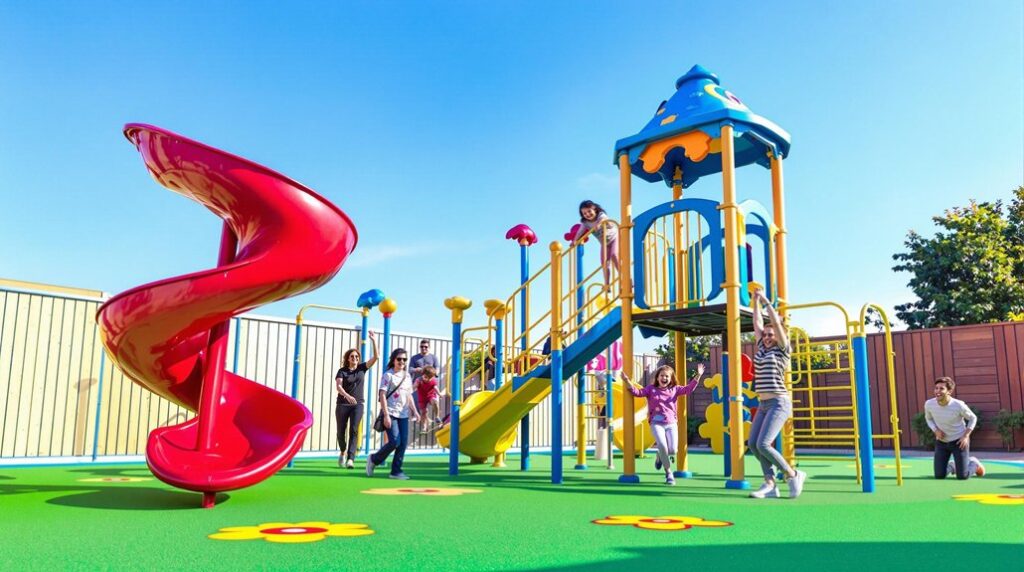
When selecting playground equipment for 3 to 5-year-olds, prioritize safety and educational value. Focus on age-appropriate climbing structures, slides, and activity panels that encourage active play and social interaction. Make certain the equipment is under 1.5 meters high, easily supervised, and designed to enhance motor skills and cognitive development. Additionally, incorporate interactive and sensory play elements to foster creativity and exploration. Exploring various types can provide insights into the full range of benefits available for young children.
Types of Playground Equipment
When considering playground equipment for 3-5-year-olds, it’s essential to understand the various types available, as each serves distinct developmental purposes. Climbing structures like step ladders and stairways offer safe ascent, while activity panels engage children with interactive puzzles. Slides, including straight and spiral designs, provide exhilarating yet secure experiences. Play units, such as integrated structures and theme-based playsets, foster imaginative play and social interaction. For balance and coordination, rotational equipment like merry-go-rounds and seesaws are beneficial. Finally, interactive and sensory play equipment, including musical instruments and water tables, encourage exploration and creativity. Each type of equipment contributes uniquely to physical, cognitive, and social development, making thoughtful selection vital for early childhood play environments. Additionally, incorporating thermoplastic playground markings can enhance safety and organization in play areas, supporting structured outdoor activities.
Safety Considerations
Guaranteeing the safety of playground equipment for 3-5-year-olds involves an extensive understanding of various factors that contribute to a secure environment. First, choose age-appropriate equipment, confirming it’s under 1.5 meters high. Regularly inspect the playground surface for adequate cushioning and avoid playing on wet equipment to minimize slip hazards. Adult supervision is vital to intervene in potential dangers, while teaching children to use equipment properly and take turns can reduce congestion. Additionally, maintain clear zones around equipment to prevent tripping and confirm proper spacing to avoid collisions. Finally, be mindful of equipment temperatures to prevent burns and avoid clothing with cords that might pose entanglement risks. Regular maintenance and safety checks are essential for a secure playground experience, and implementing durable playground markings can further enhance safety and organization in play areas.
Educational Benefits
Playground equipment for 3-5-year-olds offers a multitude of educational benefits that greatly contribute to their overall development. Engaging with various play structures enhances cognitive skills, as children solve problems and make decisions during unstructured play. Activities like climbing and sliding improve motor skills, while nature-themed equipment fosters curiosity and exploration. Socially, cooperative play on seesaws and swings promotes teamwork and communication, helping children learn conflict resolution. Emotionally, active play builds confidence and resilience, allowing children to take calculated risks. Additionally, sensory experiences from sand and water play stimulate creativity, while interactive learning tools enhance cognitive growth. Overall, playground equipment serves as a multifaceted educational resource, promoting physical, cognitive, emotional, and social development in young children. Moreover, incorporating durable thermoplastic materials ensures that the play structures withstand heavy use, providing a safe and engaging environment for children.