
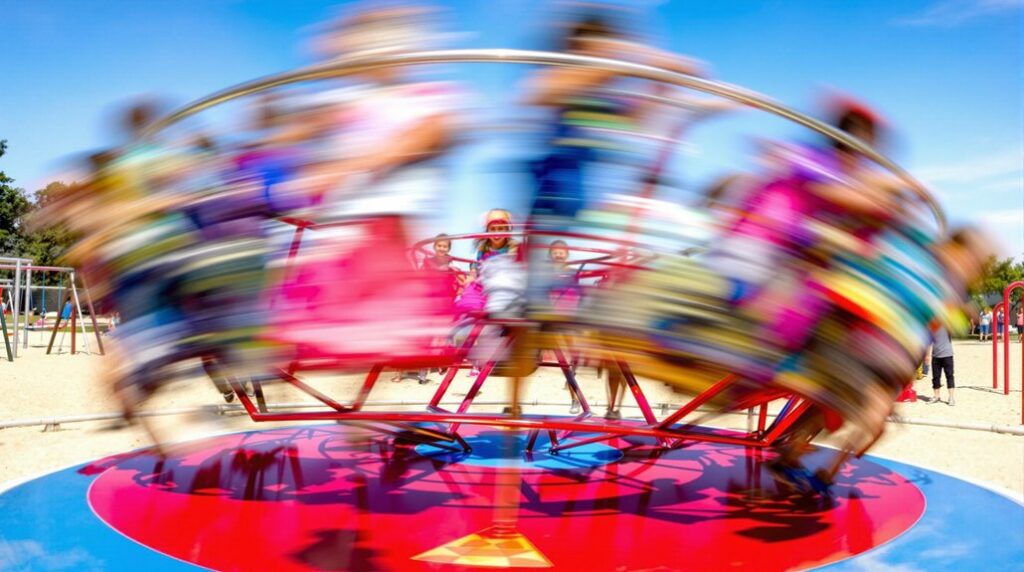
A playground roundabout operates by using a flat disk mounted on a central pivot, allowing it to rotate freely when pushed or pulled. This spinning motion creates vestibular stimulation, essential for children’s sensory processing. Some models have a slight tilt, enhancing speed through angular momentum. Variants like the HAGS Pedal Roundabout incorporate exercise through pedaling, while designs focus on safety with hand-holds and anti-slip surfaces. To fully appreciate their multifaceted benefits, consider exploring further details.
Definition and Structure of Playground Roundabouts
A playground roundabout, often referred to as a merry-go-round or carousel, is a popular piece of recreational equipment designed to provide children with a dynamic play experience. Typically, these structures measure between 2 to 3 meters in diameter, allowing multiple children to sit or stand while it spins. Riders utilize hand-holds and leaning support bars to maintain balance during motion. The spinning action can be initiated by pushing or pulling on handles, running around the outside, or starting from a stationary position. Some designs feature tilting mechanisms that leverage angular momentum, enabling higher speeds after an initial push. Additionally, variants like the HAGS Pedal Roundabout incorporate exercise bikes, allowing children to pedal and generate movement, enriching their play experience. To enhance safety during play, many playgrounds utilize child safe thermoplastic for their roundabout surfaces, ensuring a slip-resistant experience for all riders.
Mechanisms of Motion
Mechanisms of motion in playground roundabouts are designed to optimize the spinning experience for children by utilizing simple physics principles. Typically, a flat disk is mounted on a central pivot, allowing it to rotate freely when children apply force through pushing, pulling, or running around its perimeter. This design may include a slight tilt, enhancing rotational speed due to angular momentum, which facilitates faster spins after an initial push. Additionally, modern variants, like the HAGS Pedal Roundabout, integrate exercise bikes that enable children to propel the roundabout through pedaling. The spinning motion not only entertains but also provides vestibular stimulation, which is particularly beneficial for children with sensory processing needs, enhancing their play experience and sensory integration.
Variants of Roundabouts
While traditional roundabouts offer a classic spinning experience, numerous variants have emerged, each designed to enhance play and engagement through innovative features. For instance, the HAGS Pedal Roundabout incorporates exercise bikes, allowing children to propel it while promoting fitness. Another notable design is the Roundabout PlayPump, which not only provides entertainment but also pumps clean drinking water, with around 600 units installed in South Africa. Tilted roundabouts increase spinning speeds due to angular momentum, delivering a more exhilarating ride. Additionally, the Louden Whirl-Around presents a unique spinning experience compared to conventional flat designs. It’s also interesting to note that terminology varies; in American English, they’re often called “merry-go-rounds,” while Australians refer to them as “carousels.”
Benefits of Roundabout Play
Roundabout play offers a multitude of developmental benefits for children, greatly contributing to their physical and social growth. Engaging in roundabout activities provides essential vestibular stimulation, particularly aiding children with autism in developing sensory processing skills. It also enhances kinaesthetic awareness, enabling kids to better navigate their body movements in space. Regular use of roundabouts builds strength, coordination, and balance through active play, fostering overall motor skill improvement. In addition, the cooperative nature of roundabout play encourages social interaction, promoting teamwork and communication skills among peers. By participating in this dynamic form of play, children not only enjoy themselves but also cultivate essential life skills that will benefit them in various aspects of their development.
Therapeutic Effects on Children
Engaging in play on roundabouts can greatly enhance children’s therapeutic experiences, particularly for those with developmental challenges. The vestibular stimulation provided by roundabouts is especially beneficial for children with autism, as it helps them develop essential sensory processing skills. Furthermore, the dynamic movements on roundabouts improve children’s kinaesthetic awareness, promoting better body movement and spatial orientation. Regularly using roundabouts fosters physical activity, which can lead to enhanced strength, coordination, and balance. Additionally, the therapeutic effects extend to social interactions, as children often engage in cooperative play while using this equipment. Research shows that play on roundabouts contributes to emotional well-being, reducing anxiety and increasing enjoyment during playtime, making them a valuable addition to playgrounds.
Safety Features and Considerations
Safety is a paramount concern when it comes to playground equipment, particularly for structures like roundabouts that involve dynamic movement. To enhance safety, playground roundabouts are designed with hand-holds and leaning supports, providing stability and preventing falls. Many feature anti-slip surfaces, which greatly reduce the risk of slipping during play. Their low-to-the-ground structure minimizes the distance of potential falls, further decreasing injury risks. Regular safety inspections and maintenance are essential; they make certain that all components, such as bars and spinning mechanisms, remain in good working condition. Additionally, compliance with safety standards set by organizations like SATRA is vital, as it guarantees that roundabouts can withstand extensive use while maintaining a safe environment for children.
Innovations in Playground Roundabouts
As playgrounds evolve, innovations in roundabouts have emerged, transforming traditional play structures into multifunctional tools that promote physical activity and community benefits. One notable example is the HAGS Pedal Roundabout, which integrates exercise bikes, enabling children to propel the roundabout while engaging in fitness. Similarly, the Roundabout PlayPump, invented in 1989, cleverly harnesses the spinning motion to pump clean drinking water from underground sources, with approximately 600 installations in South Africa benefiting about one million people. However, its effectiveness as a power source has faced scrutiny. Additionally, innovative designs like the Louden Whirl-Around enhance sensory experiences, emphasizing that modern roundabouts can serve as essential community resources through integrated technologies, combining play with practical benefits.
Encouraging Social Interaction Through Play
Playground roundabouts serve as dynamic platforms for social interaction, requiring multiple children to collaborate in order to spin and balance effectively. This cooperation fosters teamwork, as children must push or pull together, enhancing their ability to communicate and negotiate roles. As they engage in this cooperative play, they develop essential communication skills, learning to articulate ideas and preferences. Roundabouts also create inclusive environments, allowing children of varying ages and abilities to interact, thereby promoting understanding and empathy among peers. The spontaneous nature of roundabout play encourages children to take turns and share experiences, further enhancing social connections. Ultimately, these shared moments can lead to stronger friendships, as collaborative activities often forge lasting social bonds.